
The Proof, Not The Hype
First edition; 240 pages
ISBN 0-13-231184-4
( by: Harris Kern, Randy Johnson, Michael Hawkins, and Andrew Law with William Kennedy )
Table of Content
Foreword
Acknowledgments
About the Authors
Preface
- IT in the New Enterprise
IT in the New Enterprise
The New Enterprise
Legacy Concepts
The Network is the Data Center
Re-Engineering IT
Personalized Communications
Those People Issues
Morale and Compensation - Production-Quality Enterprise Networks
Characteristics of an Enterprise Network
Guidelines for Success
Cost of Ownership
A Multidimensional Approach - Steps Toward a Network Architecture
Analyzing Requirements
Key Pieces of the Network Requirements Puzzle
Design for Success — They’ll tell you
Functionality, Performance, Reliability
Key Methods for the Network Architecture
Standards Issues
Survey Technologies and Trends
Logical Network Topology
Subnets and Workgroups
Management and Security - Building a Distributed Network
Distributed Facilities
Structured Cabling
Cabling Types and Standards
EIA, IEEE, and ANSI Standards
Connectors and Adapters
Other Cabling Issues
The Backbone Network
Segmented Backbone Networks
Subnets and Access
Topographies
Concentrators and Connectivity
High-Speed Networking Technologies
Internetworking and Interoperability
Wide Area Networking and Beyond
Internet
Nomadic Connections - Networking Platforms, Protocols, and Management
One or Many Voices?
Multiprotocol Networks
Mainframe Connectivity
Server Connectivity
Desktop Client Connectivity
Network Management Platform and Standards
Network Management Applications
Special Network Management Tools
Remote Network Management
Network Security
Encryption
Eavesdropping Protection and Intrusion Detection
Remote Dial-in Security
Firewalls - Network Standards and Procedures
Organization and Personnel
Management Standards and Procedures
Documentating the Network
Names and Addresses
Performance and Security
Centralized Configuration and Management
Problem Recovery - The New Enterprise Data Center
More, Not Fewer
Data Center Services
Reliability, Availability, and Serviceability
Data Center Organization
Technical Support
Database Administration
Computer Operations
Data Center Standards
Hardware Standards
Disk Configuration Standards
Software Standards
Database Standards
Security Standards - Data Center Processes and Tools
Managing Change
Change Management Process
Change Request Procedure
Release Distribution/Configuration Management
Disk Management
Reliability
Availability
Serviceability
Being Proactive
Managing Availability
Preventive Maintenance
Disaster Recovery
Scheduling
Console Server
Tape Management
Performance Monitoring and Capacity Planning
Footprint Request
Automated Paging
Problem Management
Security - Client/Server Production Acceptance
Our #1 Priority
The CSPA Chronicle
Contents of the CSPA
The CSPA Process
There are Four Phases to the Process
Personalized Communications
Service Level Agreements
Roles and Responsibilities
Production Application Tracking
What IT Should/Should Not Support
Tips for Success or Failure
CSPA Signoff Sheet - Managing Customer Expectations (Including the Desktop!)
Mission Critical Desktops
Dataless Desktops
Savings Through Centralization
Desktop System Administration
Chargeback
IT-Customer Budget Collaboration
Our Chargeback Methods - The Proof: A Case Study in Client/Server Security
Securing the JIT
Client/Server Security Architecture
Server Security
Application Security
The Proof, Not The Hype
First edition; 240 pages
ISBN 0-13-231184-4
( by: Harris Kern, Randy Johnson, Michael Hawkins, and Andrew Law with William Kennedy )
Preface
In our first book, Rightsizing the New Enterprise we presented our real-world experiences — the proof, not the hype-transitioning Sun Microsystems’ corporate production-computing systems from a central mainframe to a distributed client/server environment. We talked about the new technologies and the role of Information Technology (IT) in this new computing paradigm. The goal is to “rightsize” the enterprise; to get the right information to the right people to support business requirements.
In this book, Managing the New Enterprise, we expand on the themes of the first book Rightsizing the New Enterprise and discuss how to build and manage a heterogeneous client/server environment. We describe in detail the key technology support infrastructures, including networking, data centers, and system administration. We also explain how IT must change to manage the New Enterprise.
What is this New Enterprise? It’s what businesses or corporations must do to survive in the 1990s. Businesses are changing and so must IT to meet the new business requirements. Global competition is becoming more intense, profit margins are falling. To remain competitive, the New Enterprise must diversify and focus on products and services that provide a competitive advantage, all this while reducing costs.
When we were “volunteered” to transition Sun’s production systems to client/server distributed computing in late 1989, most of our issues dealt with the new technologies. We had to invent, develop, and implement new technologies to meet IT goals in the new environment. Our goal was to provide the same reliability, availability, and serviceability (RAS) that we delivered in our mainframe environment. If we didn’t, our customers — the users — would blame you know what? That’s right: the new technologies! Even at Sun, which was in the vanguard promoting the new computing paradigm for businesses.
In today’s world, the tools and technologies that help IT build, implement, and deliver RAS-disciplined mission-critical applications are now commercially available and mature. Managing the New Enterprise is no longer a technology problem. It’s all about change. It’s a cultural issue. IT must change the way they do business to survive. And the key to success is to re-engineer IT. We had to re-engineer ourselves while re-engineering business practices to be successful and to survive. We had to deal with executives who were advising that we “blow up the glass house.” They felt there was no longer a need for any centralized IT functions like a data center. We proved them wrong! How? Read this book and find out.
Who Should Read This Book Managing the New Enterprise is intended for the chief information officer (CIO), vice president of IT, chief technologist, architects, and line managers within IT (applications developers, networking specialists, telecommunications professionals, and computer operators) who are facing the challenges of building and managing the New Enterprise. This book is a survival guide. It’s about how you must change to be successful.
 Dennis Horgan is a consultant with Sun Microsystems specializing in enterprise architecture and IT transformation. Prior to joining Sun, Horgan held several IT management positions at NASA’s Jet Propulsion Laboratory. He has degrees in electrical engineering from UC Davis and MIT, and an MBA from UCLA.
Published Works
Architecture and Implementation
First edition; 288 pages
ISBN 0-13-080902-0
( by: Mark Humphries, Michael Hawkins and Michelle C. Dy )
Table of Content
I. INTRODUCTION.
1. The Enterprise IT Architecture.
The Past: Evolution of Enterprise Architectures. The Present: The IT Professional’s Responsibility. Business Perspective. Technology Perspective. Architecture Migration Scenarios. Migration Strategy: How Do We Move Forward?
2. Data Warehouse Concepts.
Gradual Changes in Computing Focus. The Data Warehouse Defined. The Dynamic, Ad Hoc Report. The Purposes of a Data Warehouse. A Word about Data Marts. A Word about Operational Data Stores. Data Warehouse Cost-Benefit Analysis / Return On Investment.
II. PEOPLE.
3. The Project Sponsor.
How Will a Data Warehouse Affect our Decision-Making Processes? How Does a Data Warehouse Improve My Financial Processes? Marketing? Operations? When Is a Data Warehouse Project Justified? What Expenses Are Involved? What Are the Risks? Risk-Mitigating Approaches. Is My Organization Ready for a Data Warehouse? How Do I Measure the Results?
4. The CIO.
How Do I Support the Data Warehouse? How Will My Data Warehouse Evolve? Who Should Be Involved in a Data Warehouse Project? What Is the Team Structure Like? What New Skills Will My People Need? How Does Data Warehousing Fit into My IT Architecture? How Many Vendors Do I Need to Talk To? What Should I Look for in a Data Warehouse Vendor? How Does Data Warehousing Affect My Existing Systems? Data Warehousing and its Impact on Other Enterprise Initiatives. When Is a Data Warehouse Not Appropriate? How Do I Manage or Control a Data Warehouse Initiative?
5. The Project Manager.
How Do I Roll Out a Data Warehouse Initiative? How Important Is the Hardware Platform? What Technologies Are Involved? Do I Still Use Relational Databases for Data Warehousing? How Long Does a Data Warehousing Project Last? How Is a Data Warehouse Different from Other IT Projects? What Are the Critical Success Factors of a Data Warehousing Project?
III. PROCESS.
6. Warehousing Strategy.
Strategy Components. Determine Organizational Context. Conduct Preliminary Survey of Requirements. Conduct Preliminary Source System Audit. Identify External Data Sources (If Applicable). Define Warehouse Rollouts (Phased Implementation). Define Preliminary Data Warehouse Architecture. Evaluate Development and Production Environments and Tools.
7. Warehouse Management and Support Processes.
Define Issue Tracking and Resolution Process. Perform Capacity Planning. Define Warehouse Purging Rules. Define Security Measures. Define Backup and Recovery Strategy. Set Up Collection of Warehouse Usage Statistics.
8. Data Warehouse Planning.
Assemble and Orient Team. Conduct Decisional Requirements Analysis. Conduct Decisional Source System Audit. Design Logical and Physical Warehouse Schema. Produce Source-to-Target Field Mapping. Select Development and Production Environment and Tools. Create Prototype for This Rollout. Create Implementation Plan for this Rollout. Warehouse Planning Tips and Caveats.
9. Data Warehouse Implementation.
Acquire and Set Up Development Environment. Obtain Copies of Operational Tables. Finalize Physical Warehouse Schema Design. Build or Configure Extraction and Transformation Subsystems. Build or Configure Data Quality Subsystem. Build Warehouse Load Subsystem. Set-up Data Warehouse Schema. Set Up Data Warehouse Metadata. Set Up Data Access and Retrieval Tools. Perform the Production Warehouse Load. Conduct User Training. Conduct User Testing and Acceptance.
IV. TECHNOLOGY.
10. Hardware and Operating Systems.
Parallel Hardware Technology. Hardware Selection Criteria.
11. Warehousing Software.
Overview. Middleware and Connectivity Tools. Extraction Tools. Transformation Tools. Data Quality Tools. Data Loaders. Database Management Systems. Metadata Repository. Data Access and Retrieval Tools. Data Modeling Tools. Warehouse Management Tools. Source Systems.
12. Warehouse Schema Design.
OLTP Systems Use Normalized Data Structures. Dimensional Modeling for Decisional Systems. Two Types of Tables: Facts and Dimensions. A Schema Is a Fact Table and Its Related Dimension Tables. Facts Are Fully Normalized, Dimensions Are Denormalized. Dimensional Hierarchies and Hierarchical Drilling. The Time Dimension. The Grain of the Fact Table. The Fact Table Key Is the Concatenation of Dimension Keys. Aggregates or Summaries. Dimensional Attributes. Multiple Star Schemas. Core and Custom Tables.
13. Warehouse Metadata.
Metadata Are a Form of Abstraction. Why Are Metadata Important? Metadata Types. Versioning. Metadata as the Basis for Automating Warehousing Tasks.
14. Warehousing Applications.
The Early Adoptors. Types of Warehousing Applications. Specialized Applications of Warehousing Technology.
V. WHERE TO NOW?
15. Warehouse Maintenance and Evolution.
Regular Warehouse Loads. Warehouse Statistics Collection. Warehouse User Profiles. Security and Access Profiles. Data Quality. Data Growth. Updates to Warehouse Subsystems. Database Optimization and Tuning. Data Warehouse Staffing. Warehouse Staff and User Training. Subsequent Warehouse Rollouts. Chargeback Schemes. Disaster Recovery.
16. Warehousing Trends.
Continued Growth of the Data Warehouse Industry. Increased Adoption of Warehousing Technology by More Industries. Increased Maturity of Data Mining Technologies. Emergence and Use of Metadata Interchange Standards. Increased Availability of Web-Enabled Solutions. Popularity of Windows NT for Data Mart Projects. Availability of Warehousing Modules for Application Packages. More Mergers and Acquisitions Among Warehouse Players.
VI. Appendices.
Appendix A. R/olapXL? User,s Guide.
Appendix B. Warehouse Designer? User’s Manual.
Appendix C. Online Data Warehousing Resources.
Appendix D. Tool and Vendor Inventory.
Appendix E. Software License Agreement.
VII. REFERENCES & FURTHER READING.
Architecture and Implementation
First edition; 288 pages
ISBN 0-13-080902-0
( by: Mark Humphries, Michael Hawkins and Michelle C. Dy )
Preface
This book is intended for Information Technology (IT) professionals who have been hearing about or have been tasked to evaluate, learn or implement data warehousing technologies.
Far from being just a passing fad, data warehousing technology has grown much in scale and reputation in the past few years, as evidenced by the increasing number of products, vendors, organizations, and yes, even books, devoted to the subject. Enterprises that have successfully implemented data warehouses find it strategic and often wonder how they ever managed to survive without it in the past.
As early as 1995, a Gartner Group survey of Fortune 500 IT managers found that 90 percent of all organizations had planned to implement data warehouses by 1998. Virtually all Top-100 US banks will actively use a data warehouse-based profitability application by 1998. Nearly 30 percent of companies that actively pursue this technology have created a permanent or semipermanent unit to plan, create, maintain, promote, and support the data warehouse.
If you are an IT professional who has been tasked with planning, managing, designing, implementing, supporting, or maintaining your organization’s data warehouse, then this book is intended for you. The first section introduces the Enterprise Architecture and Data Warehouse concepts, the basis of the reasons for writing this book.
The second section of this book focuses on three of the key People in any data warehousing initiative: the Project Sponsor, the CIO, and the Project Manager. This section is devoted to addressing the primary concerns of these individuals.
The third section presents a Process for planning and implementing a data warehouse and provides guidelines that will prove extremely helpful for both first-time and experienced warehouse developers. The fourth section of this book focuses on the Technology aspect of data warehousing. It lends order to the dizzying array of technology components that you may use to build your data warehouse. The fifth section of this book opens a window to the future of data warehousing.
This book also comes with a CD-ROM that contains two software products. Please refer to the readme.txt file on the CD-ROM for any last minute changes and updates.
The enclosed software products are:
- R/olapXL — R/olapXL is a powerful query and reporting tool that allows users to draw data directly into Microsoft Excel spreadsheets from any dimensional data mart or data warehouse that resides on an ODBC-compliant database. Once the data are in Microsoft Excel, you are free to use any of Excel’s standard features to analyze, report, or graph the retrieved data.
- Warehouse Designer — Warehouse Designer is a tool that generates DDL statements for creating dimensional data warehouse or data mart tables. Users specify the required data structure through a GUI front-end. The tool generates statements to create primary keys, foreign keys, indexes, constraints, and table structures. It recognizes key dimensional modeling concepts such as fact and dimension tables, core and custom schemas, as well as base and aggregate schemas.
Also enclosed is a License Agreement that you must read and agree to before using any of the software provided on the disk. Manuals for both products are included as appendices in this book. The latest information on these products is available at the website of Intranet Business Systems, Inc. The URL is http://www.intranetsys.com.
 Michelle C. Dy heads the Business Analytics Practice of Intranet Business Systems, Inc. She specializes in methodology consulting, data warehouse planning, and implementation. She is responsible for defining Intranet’s data warehousing methodology.
Published Works
Mark W. Humphries is President and CEO of Intranet Business Systems, Inc., a professional services firm that specializes in Business Intelligence consulting and implementation. He has over 16 years of experience in management and IT consulting in Europe, North America, and Asia. He has led large, enterprise-wide data warehousing implementations in the banking, telecommunications, and utilities industries. More recently, he has been focused on strategic, multi-company warehousing initiatives.
Published Works
The Sirens’ Song
First edition; 288 pages
ISBN 0-13-035389-2
( by:Mitch Peterson, Steve O’Conner, Harris Kern, Thomas Lah )
Table of Content
Introduction – Why Product Companies Jump In
- The Sirens’ Song of Services
- The Product-Services wheel
- Good Reasons to Offer New Services
Chapter 1: Mapping the Voyage
- Parameters for Success
- Primary Audience
- Chapter Structure
- Secondary Audiences
- Chapter Overview Table
Chapter 2 : Setting the Parameters
- Are you Sure? Four Qualifying Questions
- Mission
- Format
- Audience
- Overarching Objective
- Mission and the SAR Factor
- Business Model
- Objectives
- Guiding Principles
Chapter 3 : Level of Profitability
- Revenue
- Revenue Types
- Revenue Mix
- Revenue Growth Rate
- References
- Product References
- Capabilities References
- Solution References
- Industry References
- Repeatability
- Tale of Two Business Units
Chapter 4 : Organizational Overview
- Professional Services Functional Map
- Selling
- Delivering
- Productizing
- Promoting
- Operations
- Professional Services O-Map
- General PS Interfaces
- O-Map Interfaces
Chapter 5 : Selling
- Supply and Demand in Professional Services
- Warning!
- Function Overview
- Critical Success Factors
- Services Sales Charter
- Identify and Close
- Identify
- Quality
- Propose
- Negotiate
- Forecast
- Roles and Responsibilities
- Key Interfaces for Sales
- Compensation for Sale
- Key Variables
- Compensation for Sale
- Key Metrics for Sales
- Organizational Structure and Sizing
- Target Revenue
- Rep Quotas
- Geography Vs. Industry Based
- Sample Organizational Structure
- Sample Budget
- Issues to Watch
Chapter 6 : Delivering
- Function Overview
- Critical Success Factors
- Services Delivery Charter
- Estimate
- Execute
- Requirements Review
- Plan
- Design and Develop
- Implement
- Sign-Off
- Review
- Follow-On
- Educate
- Roles and Responsibilities
- Key Interfaces for Delivery
- Compensation for the Delivery Function
- Key Metrics
- Organizational Structure and Sizing
- Revenue Mix
- Billable Utilization Rate
- Billable Rate
- Sample Organizational Structure
- Sample Budget
- Issues to Watch
Chapter 7 : Productizing
- Function Overview
- Critical Success Factors
- Services Engineering Charter
- Capture
- Project Review
- Solution Review
- IP Capture
- Improve
- Solution Development
- Sample Architecture
- Sample Project Plan
- Sample Proposal
- Engagement Framework and Engagement Activity Forms
- Resource Profiles
- Partner Profiles
- Source Code
- Training Materials
- Demonstrations
- Leverage
- Solution Rollout
- Sales Support
- Solution Evaluation
- Roles and Responsibilities
- Key Interfaces for Services Engineering
- Compensation for Services Engineering Staff
- Key metrics for Services Engineering
- Organizational Structure and Sizing
- Target Mix
- Number of Solutions
- Sample Organizational Structure
- Sample Budget
- Issues to Watch
Chapter 8 : Promoting
- Function Overview
- Critical Success Factors
- Services Marketing Charter
- Differentiate
- The Solution Review
- Solution Rollout
- Campaign Development
- Validate
- Demos
- Benchmarking
- Evangelize
- Sales Training
- Channel Management
- Lighthouse Accounts
- Roles and Responsibilities
- Key Interfaces for the Services Marketing Function
- Compensation for Services Marketing
- Key Metrics for Services Marketing
- Organizational Structure and Sizing
- Unique Regions
- Number of Solutions
- Sample Organizational Structure
- Sample Budget
- Issues to Watch
Chapter 9 : Operational Infrastructure
- The Framework
- Critical Success Factors
- Operational Process
- Legal Support
- PS Automation
- Operational Reports
- Funnel Reports
- Booking Reports
- Billing Reports
- Backlog Reports
- Web Sites
- Electronic Newsletters
- Internal Distribution Lists
- Financial Reporting
- Executive Dashboard
- Metrics Reporting
- Project Processes
- Partner Management
- Resource Management
- Solutions Assurance Review
- Project Accounting
- Project Reports
- Knowledge Management
- Staff Processes
- Commission Payments
- Proposal Generation
- Professional Development
- Project Management Certification
- General training
- PS Specific Training
- Staff Reports
- Time Reporting
- Roles and Responsibilities
- Key Interface for Operations
- Compensation for Operations
- Organizational Structure and Sizing
Chapter 10 : Putting It All Together
- Organizational Parameters
- Organizational Interfaces
- Interfaces within Professional Services
- Interfaces with the Larger Company
- External Interfaces
- Interfaces by Function
- Technical Staff Vs. Sales and Marketing Staff
- Field Staff Vs. Corporate Staff
- Organizational Structure
- Roles and Responsibilities
- Processes and Metrics
- Compensation
- Business Model and Budget
- Summary
Chapter 11 : Customer Engagement Workflow
- Workflow Overview
- Step 1: Request
- Step 2: Qualify
- Step 3: Bid
- Step 4: Negotiate
- Step 5: Develop
- Step 6: Implement
- Step 7: Sign-Off
- Step 8: Review
- Summary
Chapter 12 : Four Phases of Building PS
- Overview of Phases
- Phase I- Implementation of Services
- Value Proposition
- Profitability Triangle Focus
- Critical Skills
- Required Operational Infrastructure
- Target Mix
- Revenue Growth Rate
- Target Gross Margin
- Target Operating Profit
- Phase II- Integration Services
- Value Proposition
- Profitability Triangle Focus
- Critical Skills
- Required Operational Infrastructure
- Target Mix
- Revenue Growth Rate
- Target Gross Margin
- Target Operating Profit
- Phase III- Consulting Services
- Value Proposition
- Profitability Triangle Focus
- Critical Skills
- Required Operational Infrastructure
- Target Mix
- Revenue Growth Rate
- Target Gross Margin
- Target Operating Profit
- Phase IV- Productized Services
- Value Proposition
- Profitability Triangle Focus
- Critical Skills
- Required Operational Infrastructure
- Target Mix
- Revenue Growth Rate
- Target Gross Margin
- Target Operating Profit
- Maturity Time Line
- Services Phases Graph
- Skipping a Phase
- Stalling in a Phase
- Services Market Landscape
- Hewlett Packard: More than Just an Integrator?
- Compaq: Buying Its Way Around the Wheel
- Sun: Not Sure They Want In
- EMC: Knows the Way to Go
- Management Positioning
Chapter 13 : Unique Issues
- Alignment
- Vertical Alignment: Aligning Service Solutions and Capabilities
- Horizontal Alignment: Aligning Service Departments
- Aligning Skills
- Overlap
- Partner Conflict
- Product Infrastructure Vs. Service Infrastructure
- Internal Education and Promotion
- Global Differences
- Closing Comments
Chapter 14 : Summary of Key Concepts
- The SAR Factor
- Four Qualifying Questions
- Ten Parameters for Running a Business
- Key Levers of a Professional Services Business
- Organization Structure, Metrics, and Compensation
- Business Model and Objectives
- Maturity Time Line
- Unique Issues
- Sirens’ Song
Appendix A – Evaluating Your Service Vendors
- Tier I- Solutions and Capabilities
- Tier II- Ability to Execute
- Tier III- Strategic Fit
Appendix B – Key Financial Models
Appendix C – PS Business Review
- Timing
- Attendees
- Agenda
- Sample Review Packages
Appendix D – Sample Project Review
Project Review Executive Summary
- 1.0 Project Overview
- 2.0 Project Team
- 3.0 Project Statistics
- 3.1 Phase I: Detailed Design
- 3.2 Phase II: Interpretation
- 3.3 Phase III: Project Statistics Interpretation
- 4.0 Repeatable Components
- 5.0 Conclusions
Appendix E – Solution Portfolio Management
- Solution Portfolio Graph
- Solution Revenue
- Solution Maturity
- Solution Margin
- Portfolio Ownership
- Services Marketing
- Services Engineering
Appendix F – Customer Request and Qualification Form
- Request and Qualification Form
- Customer Qualification Information
- Glossary
- Glossary Terms
- Selected Bibliography
- Index
The Sirens’ Song
First edition; 288 pages
ISBN 0-13-035389-2
( by:Mitch Peterson, Steve O’Conner, Harris Kern, Thomas Lah )
Preface
Professional Services at a Product Company
May 31st, 2001. Bill Gates grants a live interview. He appears on CNBC’s “Squawk Box” to promote Microsoft’s latest software release. Two minutes into the interview, host Mark Haines wants to know about Microsoft’s service strategy: Isn’t Mr. Gates concerned that Microsoft doesn’t enjoy the same level of service revenues that Oracle and IBM do? Mr. Gates responds that Microsoft is now offering new consulting services. A visit to the Microsoft Web page confirms the new direction. (see Fig.0-1).
A quick search on www.google.com using the key words “Professional Services” and “Product” yields hundreds of Web sites for technology product companies also offering professional services. Besides Oracle and IBM, the who’s who list includes hardware manufacturers Alcatel, Aspect, Compaq, EMC, HP, Lucent, Nortel, and Sun; software makers PeopleSoft, Sybase, WebCT, Pumatech, and Red Hat. All of these technology companies have heard it. They can’t ignore it. The Siren’s Song of Services.
Microsoft Consulting Services Portfolio of Services
Microsoft® Consulting Services(MCS) provide help directly from Microsoft through every stage of the technology planning, deployment, and support process. MCS is staffed with Microsoft experts who can help you make the most of your IT investment. Specializing in real-life IT solutions, MCS offers a full range of programs for advanced technology requirements: e-commerce, enterprise applications planning, distributed network architecture computing, and more. Customers around the world have used MCS to improve productivity and establish a competitive advantage. With more than 100 offices and just under 4,000 consultants worldwide, Microsoft has the experience and expertise to align your IT vision and business goals. The following are some of the services we offer.
The Gartner Group has documented an identity crisis that both product and service companies constantly go through: Product companies want to become service companies and service companies want to become product companies. This Product-Services wheel is shown in Figure 0-2. For product companies offering technology, the turning point begins with product services, or services offered to support the core products of the company. These are commonly known as support services. But soon, the product company may be tempted to move in a different direction.
1 There is a Tide in the Affairs of Vendors: Product or Service Business?” Gartner Group, May 2000.
2 In Chapter 12, we review the service strategies of HP, Compaq, Sun, and EMC. From this review, it should become clear why companies like Compaq are motivated to move to offer consulting services.
3 In fact, the definition of professional services is very nebulous in the industry. Figure 0-2 provides a helpful and simple way to visualize and classify the various types of service offerings in which product companies invest.
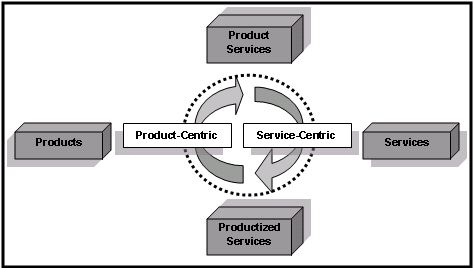
Figure 0-2 Product-Services Wheel
In particular, the Sirens’ call of potentially high growth and high-margin consulting services for a product company is almost too tempting to resist, especially if the product company is experiencing erosion in product margins. 2. If you visit the Web sites of product companies such as IBM, HP, Compaq, EMC, and Silicon Graphics, you see very consistent positioning of their newly developed services. All of these product companies now offer at least four distinct flavors of services: 3
Support Services: These are basic break-fix support services that product companies have always offered.
Education Services: These are traditional product-training services offered by product companies.
Managed Services: These are services focused on successfully implementing the core products of the company. Typically, these services are tightly scoped and very similar from customer to customer. They are usually offered at a fixed price.
Consulting (or Professional) Services: These are services that move beyond implementation and into integrating the products of the company into the customer’s business. These services may involve developing custom code to integrate the product into existing infrastructure. These services may also involve consulting with the customer on actual workflow and business processes.
For the larger product companies like IBM and HP, a fifth service is offered:
Outsourcing: These are services where the product company literally takes over the day-to-day operations of the customer’s technical environment.
Table 0-1 provides a summary of the five types of services that product companies are now likely to offer. And there is good reason for product companies to develop and offer all these new services: over half of all Information Technology (IT) spending is on services! 4 Key customers often turn to their preferred and trusted product vendors to provide more and more of these services. According to the Gartner Group, this behavior is being driven by three factors: the continuing shortage of qualified technical talent, the trend of companies to refocus on their core competencies, and the ever-increasing complexity of new technology requiring specialized expertise for successful implementation.5
4. “IT Service Spending in the Crosswinds,” p.4, The Gartner Group, September 25, 2000
5. Ibid
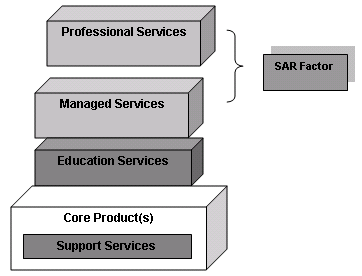
Figure 0-3 Product Services
These product companies see this opportunity for new service revenues. Figure 0-3 illustrates the traditional service opportunities on which a product company would focus: support services and education services- both are closely related to the core product of the company. But now, product companies are exploring new service opportunities that seem very attractive (light gray). There are managed services, which are more complex than standard support services but are still closely related to the products of the company. And, they are typically being delivered by support-service personnel who have downtime between support calls. This means managed services don’t represent an investment in incremental staff to deliver the services. Finally, there are professional services, which may or may not be directly related to the product, but they do represent an incremental investment in new skill types.
The nice thing about professional-services revenues is that they don’t seem to have all the messy strings attached to them that product revenues do: no product qualification process, no backwards-compatibility discussions, and no never-ending support worries. With these high-level consulting services, it appears the product-service company can be “in and out.” They collect their money and move on. Or do they? No, not really. In fact, consulting services are just as complex and risky to deliver as any new product. Every service-centric company can validate this fact. Unfortunately, no product-centric company believes it can be true. And, here begins the rub! Not only are professional services complex to deliver, there are business risks to providing professional services that many product companies do not understand at first. If the new professional services offered by the product company are not aligned and somehow anchored to their product, there is the risk that the services will be both unprofitable and counterproductive to the objectives of the product company. We refer to this risk as the services alignment risk (SAR) factor. In chapter 2, we discuss this risk factor in more detail.
One of the oldest stories known to western Civilization is the Odyssey composed by the Greek poet Homer. In the story of the Odyssey, there is a conflict between a man named Odysseus and the Greek god Poseidon. Poseidon does not want Odysseus to return home to Ithaca, so the god hurls one challenge after another toward the tormented man. But this is not the true conflict. The defining conflict Odysseus faces is between intelligence and his arrogance. On the hand, he is a very smart man. His wits brought about the fall of Troy (it was his idea to build the Trojan horse), and his wits allow him to survive each challenge the gods present. But his intelligence and success make him arrogant-arrogant enough to believe he needs no assistance from any man or any god. This arrogance fuels the wrath of Poseidon. Not until Odysseus acknowledges his limitations is he permitted to return home.
Product companies face the identical challenge that Odysseus faced. They are skilled and successful at bringing products to market. They have money from lucrative product margins to invest in new endeavors. They are confident in their business savvy. But this confidence becomes a harmful blinder as they enter the world of providing services.
When service points are thin or customer engagements go awry, the product company has difficulty acknowledging it has entered a new realm- a realm where the natural laws are different, requiring new frameworks to succeed. This reality leads us to our first “Sirens’ Song.” Throughout this book, we will be highlighting false perceptions held by many product companies regarding professional services. Because these perceptions can prove deadly, we have named them Sirens’ Songs after the beautiful yet deadly monsters from the Odyssey. These Sirens were creatures that sang enchantingly to passing sailors, only to lead the sailors to crash into unseen boulders. The misperceptions we will be highlighting have the same effect: If they are not recognized, they can lead a product company to crash its service business.
Now, for our first Sirens’ Song of Services:
Sirens’ Song: Professional services are not dramatically different from support services or education services.
Boulder Ahead: The truth is professional services are dramatically different from other services typically offered by product companies. They are different in size, scope, and risk. They operate under a different financial model. Finally, they are the first service a product company offers that does not have to be directly linked to the product portfolio of the company.
Have we scared you? Good. But don’t get too scared. Despite the potential hazards, there are many compelling reasons for a product-centric company to move forward from basic support services.
Good Reasons to Offer New Services
Beyond pursuing additional revenue opportunities, there are many sound business reasons product companies offer more than just product support services. The Services Marketing Advisors Association provides this standard list of reasons: 6
- Client interest in business solutions as opposed to point products
- Deeper client relationships and improved account control
- Increased revenue per customer:
- 50 to 100 percent higher revenues from both products and services
- Product pull-through 8
- Increased margins
- Greater implementation control
- Improved customer satisfaction
In Living on the Fault Line, Geoffrey Moore provides an updated list of why technology companies specifically need an internal professional-services organization:
- To help implement projects that advance the company’s state of the art, featuring products that are fresh from R & D.
- To do the gritty, unglamorous work behind the scenes that has to be done to make the system work right. This is the very work that independent consulting firms want no part of.
- To develop domain expertise in one or more vertical markets to help differentiate the company’s existing products.
Moore states that by providing professional services, a product company can take on problems for long-established customers that no one else will tackle. “Not only does this help secure long-term loyalty and commitment, but it can also lead to the discovery of new market opportunities.” 9
And in reality, there are benefits to the end customer. By providing consulting services directly, the product-centric company can succeed in the following ways:
- Provide one-stop shopping for implementation
- Provide hard-to-find product expertise and technical skills
- Decrease time to complete the customer solution
- Allow customers to focus on their core competencies
- Provide a single point of contact
- Provide a single point of liability
These last two points are especially attractive to understaffed, overworked IT managers who have enough vendor relationships to juggle as it is. When coauthor Steve O’Connor was CIO at silicon Graphics, he drove his IT organization to work with a short list of seven strategic vendors. “I didn’t feel my management (team) and I could build effective relationships with more than seven vendors.” The practice reclaims cycles for the IT management team and creates deeper, more productive relationships with vendors.
6. “Training Fish to Fly? Seven Tips to Convert a Product Sales Force to Solutions Selling,” June 2001, www.itsma.com/education/prof_dev/pd_052901.html.
7. “Should Professional Services Be in Your Company’s Services Portfolio?” Shera Mikelson, Hahn Consulting.
8. Product pull-through is the act of leading with service sales and then pulling product sales in.
9. Geoffrey Moore, Living on the Fault Line, New York: Harper Collins, 2000
So, with a win-win situation in mind, the product company cranks the product-service wheel and begins offering new services to the customer.
The customer buys them. And then, the real fun begins: the fun of actually delivering these services in a consistent and profitable manner. For most product companies, this is when the journey begins to get rough. Engineering and implementing products profitably is one set of skills, doing the same for services is quite another. The principles are often the same, but their application is very different. If services are not managed properly, the product company may soon find its hard-won product margins being used to subsidize unprofitable service engagements.
Sirens’ Song: Professional services should be a high-margin component of a product company’s portfolio.
Boulder Ahead: The truth is many product companies are experiencing lower than expected margins from their professional-services business. Gross margins for professional -services business units have been running at 15 percent to 20 percent with net operating profits of zero.
In reality, some of the best and brightest product companies have struggled to maintain a profit in the journey of building a services organization. 10 IBM is used constantly as the poster child for success-a model for how a product company can transition itself into a true service and solution provider. But how many companies have the deep pockets of IBM? How many companies have a locked-in legacy install base that can carry them through the painful and unprofitable transition IBM went through? Not many. And, how many other examples of success have you read about? How long is the list of product companies that have actually developed a successful and profitable service organization that offers more than basic support services? The number of articles describing product companies that want to offer more complex services is endless. The number of articles documenting favorable results is almost nonexistent.
We know the service waters look inviting. We know you want to set sail. But are you prepared to navigate these waters? Have you built the right ship? Do you have the right maps? If the answer is no, not even Poseidon himself will be able to save you from the shipwreck ahead. This book is designed to help the product company listen to the Sirens’ Song of services without the sailing into the rocks, to help the product company succeed as it turns the product -service wheel without succumbing to blind arrogance.
10. “Should Professional Services Be in Your Company’s Services Portfolio?” Shera Mikelson, Hahn Consulting
 Thomas has held many roles in both I/T and consulting over the past fifteen years. Previous roles include Business Development Manager, Regional Sales Director, and Senior I/T Development Manager. Most recently, Thomas was Director of Solutions Engineering at Silicon Graphics where his team was responsible for developing and launching consulting solutions on a global basis. He received an undergraduate degree in Information Systems and holds an MBA from the Fisher College of Business at The Ohio State University.
 |
|
|||||
 |
||||||
 |
|
|||||
|
||||||
 |
|
|||||
|
||||||
 |
|
|||||
|
||||||
 |
|
|||||
|
||||||
 |
|
|||||
|
||||||
 |
|
|||||
|
||||||
 |
|
|||||
|
||||||
 |
|
|||||
|
||||||
 |
|
|||||
|
||||||
 |
|
|||||
|
||||||
 |
|
|||||
|
||||||
 |
|
|||||
|
||||||
 |
|
|||||
|
||||||
 |
|
|||||
|
||||||
 |
|
|||||
|
||||||
 |
|
|||||
|
||||||
 |
|
|||||
|
||||||